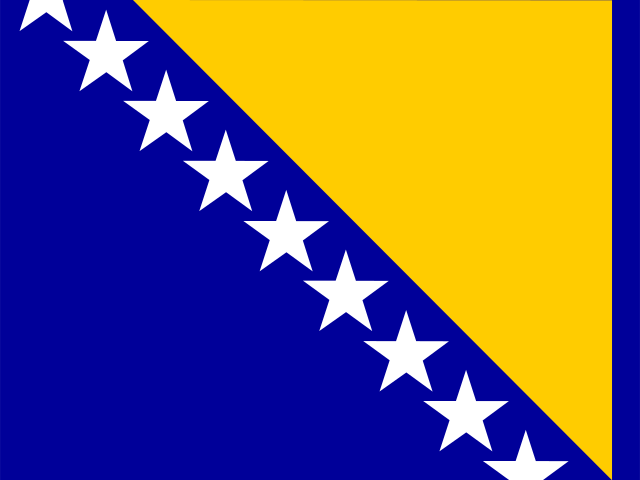
Sarajevo, the capital of Bosnia and Herzegovina, represents a powerful blend of history, culture, and sport. Located in the heart of the country, the city is naturally surrounded by the Olympic mountains of Bjelašnica, Jahorina, Igman, Treskavica, and Trebević, which have shaped its sporting identity and international recognition.
The Miljacka River flows through the city, and nearby is Vrelo Bosne, one of the most beautiful natural excursion sites in the region. Sarajevo is a city of rich history and strong character—a place where civilizations have met and some of the most important pages of European history have been written, including hosting the 1984 Winter Olympic Games.
Today, Sarajevo is a modern urban center, as well as a cultural and educational hub of the region, known for its festivals, hospitality, and unique atmosphere. As the starting point of the first stage of the Tour of Bosnia and Herzegovina, Sarajevo symbolically connects sport, tradition, and openness to the world, providing the ideal beginning for an international cycling race that promotes Bosnia and Herzegovina through elite sport. Tour of Bosnia and Herzegovina, Sarajevo simbolično povezuje sport, tradiciju i otvorenost prema svijetu, pružajući idealan početak međunarodne biciklističke utrke koja promovira Bosnu i Hercegovinu kroz vrhunski sport.
Sarajevo is home to the country’s largest higher education institution, the University of Sarajevo, along with several other universities, making it one of the largest academic centers in Southeastern Europe.
With numerous national and city theaters, museums, and cultural institutions, Sarajevo is an important center on the cultural map of this part of Europe. Each year, the city along the Miljacka hosts numerous international cultural festivals, including the Sarajevo Film Festival (SFF), Sarajevo Jazz Festival, the summer cultural festival “Baščaršija Nights,” the theater festival of new productions “MESS,” “Sarajevo Winter,” and the World Television Festival of Oriental Music.
The urban landscape of the city is marked by numerous sacred sites—mosques from the Ottoman period, Orthodox, Catholic, and Evangelical churches, a synagogue, and other cultural and historical monuments. Sarajevo is relatively small compared to major global metropolises, but thanks to its rich spiritual, historical, and natural heritage, its name is better known than some much larger cities. In 1914, Archduke Franz Ferdinand of Austria and his wife Sophie were assassinated in Sarajevo, triggering World War I. Seventy years later, in 1984, the city hosted the XIV Winter Olympic Games.
During the early 1990s, the city’s name frequently appeared on the front pages worldwide due to one of the bloodiest conflicts in recent European history. Sarajevo was under constant siege by Serbian forces for 1,425 days. During the attacks, 10,615 people of all nationalities lost their lives, including 1,601 children, and nearly 50,000 were injured.
Sarajevo is located almost at the geographic center of Bosnia and Herzegovina and covers an area of 142 km². The central parts of the city lie within the composite Sarajevo valley, stretching from east to west and ending in the Sarajevo field, while the oldest city districts (Vratnik, Bistrik, Hrid, Kovači, Alifakovac) are situated on the slopes of surrounding hills.
The Miljacka River flows through the city from east to west, originating from several springs at the foot of the Romanija and Jahorina mountains. In the western part of the Sarajevo field, near the suburban area of Ilidža, the Bosna River emerges—one of the largest rivers in Bosnia and Herzegovina—formed from around thirty smaller springs at the foot of Mount Igman, creating the unique Vrelo Bosne nature park.
The city center sits at an altitude of 511 meters above sea level. The lowest point in the Sarajevo valley is the Ilidža area at 498 meters, while higher parts of the city and suburban settlements on the surrounding hills—Grdonj and Hum to the north, Borja to the east, and the slopes of Trebević to the south—lie at an average altitude of about 900 meters. The city is surrounded by the forested slopes of the Olympic mountains, whose peaks exceed 2,000 meters: Bjelašnica (2,067 m), Jahorina (1,916 m), Igman, Treskavica, and Trebević (1,629 m).